


Key Takeaways
- A Medicare prospect list is a set of consumer records defined by a few key filters: date of birth, geography, and household attributes. Purchased lists and records pulled from a consumer database are defined by those same filters.
- The urgency of a prospect list is tied to its enrollment window, Initial Enrollment Period (IEP), Annual Enrollment Period (AEP), or Special Enrollment Period (SEP). Align your list-building and outreach timing to those dates.
- Use specific filters to create a usable prospect list: date of birth for Turning 65 (T65) timing, ZIP code or county for territory, and homeowner status or estimated income to refine your audience.
- Direct mail outreach should begin 3-5 months before a prospect’s 65th birthday; phone outreach typically starts 1-3 months before, after scrubbing against the Do Not Call registry.
- As an agent, you are responsible for following all local, state, and federal laws when contacting prospects, including Centers for Medicare & Medicaid Services (CMS) marketing guidelines, the Telephone Consumer Protection Act (TCPA), and Do Not Call (DNC) regulations, regardless of where you get the data. InfoFree is not liable for how customers use the data.
Insurance agents source medicare leads in several ways: shared or exclusive contacts from list vendors, or records pulled directly from a consumer database. Whatever the source, the same questions decide whether a list is worth working: how recent the records are, which enrollment window each consumer falls into, and how closely the list matches your territory.
Each of those questions comes down to the filters behind the list. A list of consumers approaching age 65 in a specific set of ZIP codes is a filtered view of consumer demographic data, whether it arrives from a list vendor or is pulled from a database with date-of-birth selects and geographic targeting.
This guide walks through the specific filters, enrollment-period timing, territory strategy, and compliance obligations that turn raw consumer data into a working Medicare prospect pipeline.
What a Medicare Lead Actually Is
In practice, a Medicare prospect list is a set of consumer records for people who are either approaching Medicare eligibility, currently in an enrollment window, or already enrolled and eligible for plan changes. The list’s usefulness comes from a small set of data fields: name, date of birth, mailing address, and phone number, sometimes supplemented with homeowner status or estimated income.
What separates one record from another is how recently it was pulled and where the consumer lives. A prospect list works best when its geography matches the agent’s territory and its pull date lines up with the enrollment calendar.
The common list types you will encounter are defined by which enrollment window the consumer falls into and how recently the record was generated:
- T65 (Turning 65) Lists: Consumers approaching their 65th birthday and entering their Initial Enrollment Period.
- AEP (Annual Enrollment Period) Prospect Lists: Existing Medicare beneficiaries who can make plan changes during the fall enrollment window.
- SEP (Special Enrollment Period) Prospect Lists: Consumers who can enroll or change plans outside of normal windows due to a qualifying life event, such as moving.
- Aged Prospect Lists: Records that were generated weeks or months ago and not converted, now being resold at a lower price.
Read more: Turning 65 Lead Lists – Email and Mailing Lists from InfoFree
Who Qualifies and When: The Enrollment Windows That Define Lead Timing
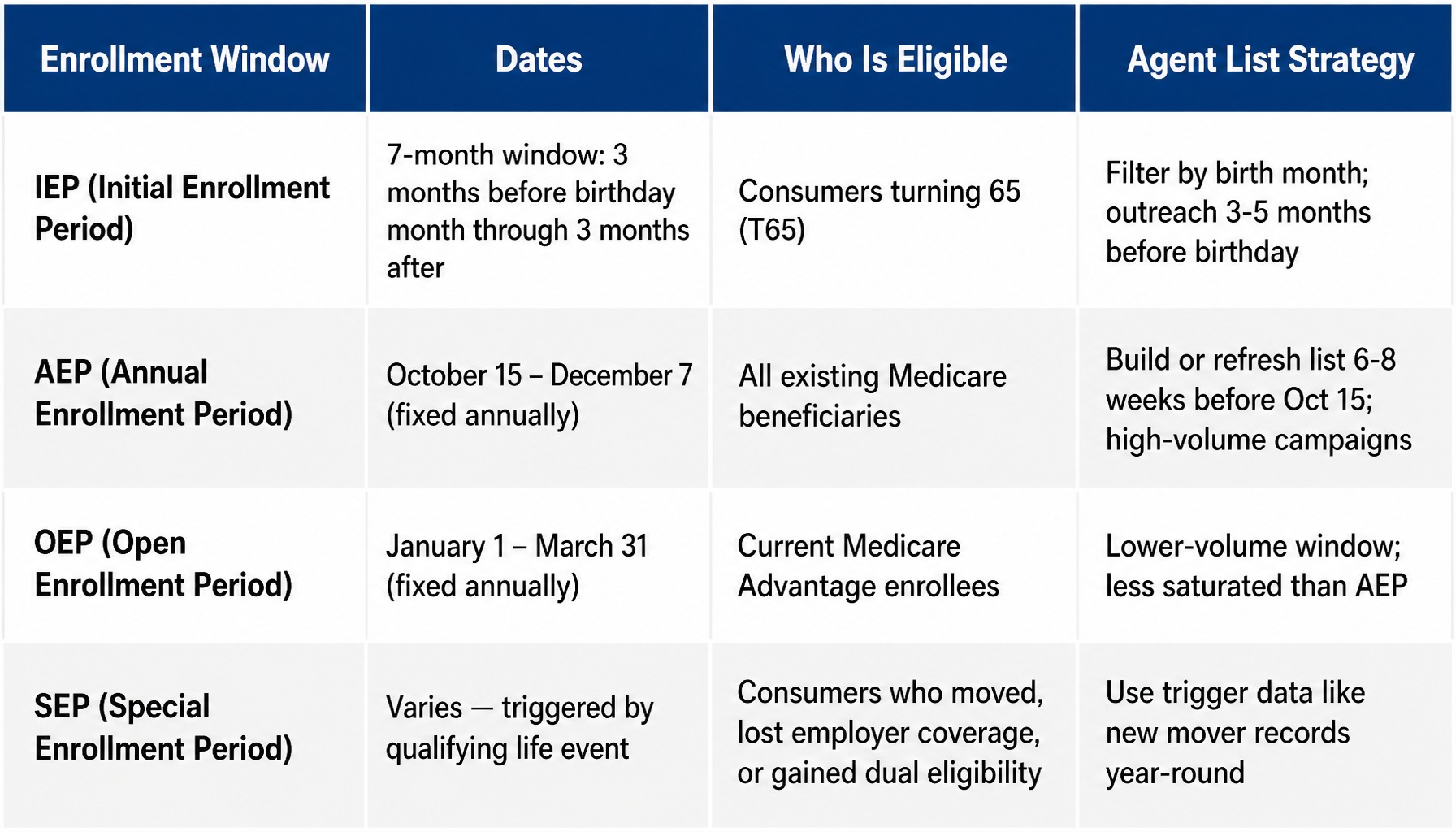
The enrollment period determines not just when a consumer can act, but what kind of decision they are making. A T65 prospect in their Initial Enrollment Period is making a first-time decision, while an AEP prospect is evaluating whether to switch from an existing plan. These are different conversations that require different list criteria. With approximately 11,000 Americans turning 65 each day, new consumers enter their IEP window every month.
For consumers born in August 1961, who turn 65 in August 2026, the Initial Enrollment Period (IEP) opens in May 2026 and closes in November 2026. This seven-month window dictates when to pull the list, when to begin outreach, and when the record loses its IEP value.
T65 and the Initial Enrollment Period
The Initial Enrollment Period (IEP) is the primary window for new beneficiaries. It is a seven-month period unique to each individual: it starts three months before their 65th birthday month, includes their birthday month, and ends three months after. “T65 lists” are built by filtering consumer records by date of birth to identify people entering this specific window.
Because the IEP is tied to an individual’s birthday, a general list of “people aged 65” is too blunt; it will include people whose enrollment window closed months ago. Precise birth-month filtering is what makes a T65 list work.
Before discussing specific plan details with any Medicare-eligible consumer, you must obtain a signed Scope of Appointment (SOA) form. This document confirms the consumer has agreed to discuss certain types of products, and it is a strict requirement from the Centers for Medicare & Medicaid Services (CMS).
Annual, Open, and Special Enrollment Periods
While the IEP is for new enrollees, other windows allow existing beneficiaries to make changes. Building lists for these periods requires a different strategy.
- Annual Enrollment Period (AEP): Runs from October 15 to December 7 each year. During AEP, beneficiaries can switch between Original Medicare and Medicare Advantage, change Medicare Advantage plans, or enroll in a Part D prescription drug plan. The window is fixed, so AEP lists need to be built and verified before October 15.
- Open Enrollment Period (OEP): Runs from January 1 to March 31. This window allows beneficiaries already in a Medicare Advantage plan to switch to another Medicare Advantage plan or back to Original Medicare. Because OEP applies only to current Medicare Advantage enrollees, an OEP list draws from a narrower pool than an AEP list.
- Special Enrollment Periods (SEPs): These are triggered by qualifying life events, such as moving to a new service area, losing employer coverage, or qualifying for both Medicare and Medicaid. An agent building their own prospect lists can use trigger data, like new mover records, to identify SEP-eligible prospects year-round.
The Filters That Shape a Usable Medicare Prospect List
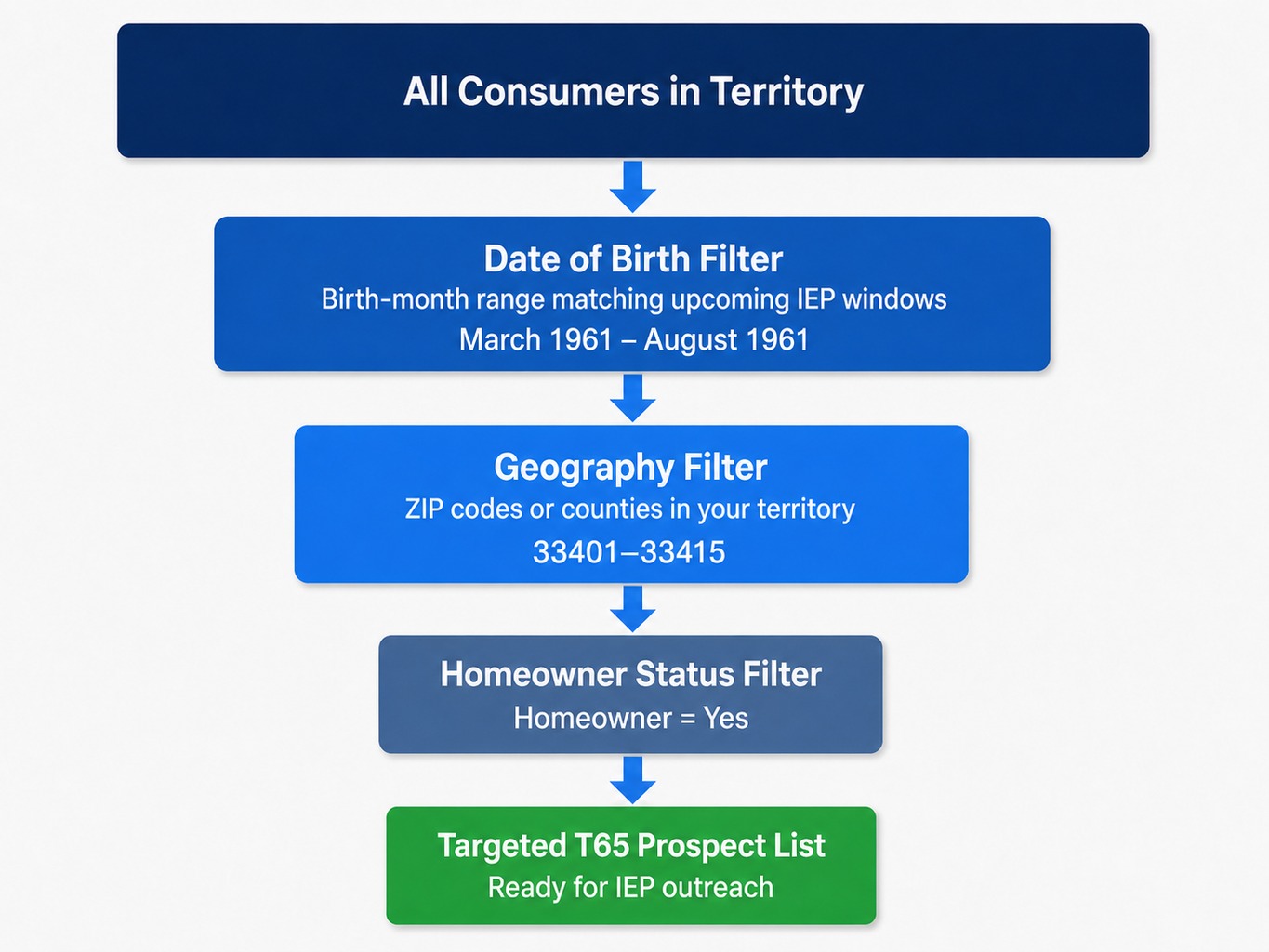
A Medicare prospect list is only as useful as the filters that built it. A list of every person aged 64-65 in a state is too broad to be effective. A list of consumers turning 65 within the next six months, in three specific ZIP codes, who are homeowners, narrows the audience to a workable call or mail list.
These are the filters that matter, in order of importance:
- Date of Birth or Age Band: This is the primary filter for T65 prospecting. Filtering by birth month and year lets you align outreach precisely with a prospect’s seven-month IEP window. For AEP or OEP campaigns, you might use a broader age band (e.g., 66-75) to target existing beneficiaries.
- Geography: Targeting by ZIP code, county, or a radius around your office is essential for defining your territory. County-level targeting often aligns with how insurance carriers define their service areas. Platforms like InfoFree allow you to search consumer records by these geographic boundaries.
- Homeowner Status: Homeowner status is a household attribute that some agents use as an indicator of financial stability. Filtering for homeowners can help refine a list for products like Medicare Supplement (Medigap) plans, which carry a monthly premium. You can access dedicated homeowner lead lists to apply this filter directly.
- Estimated Income or Home Value: For agents focusing on Medigap plans, layering an estimated income or home value filter on top of homeowner status refines the list with additional household financial data.
In practice, these filters stack: a birth-month range that matches upcoming IEP windows, the ZIP codes or counties that make up your territory, and homeowner status set to “yes.” The combination of these filters is what separates a targeted Medicare prospect list from a generic senior mailing list.
Read more: ZIP Code Mailing Lists – Buy Mailing Lists by ZIP Code from InfoFree
Timing Your Outreach: When to Mail, Call, and Follow Up
Pulling a list is step one. When and how you contact those prospects determines whether the list converts.
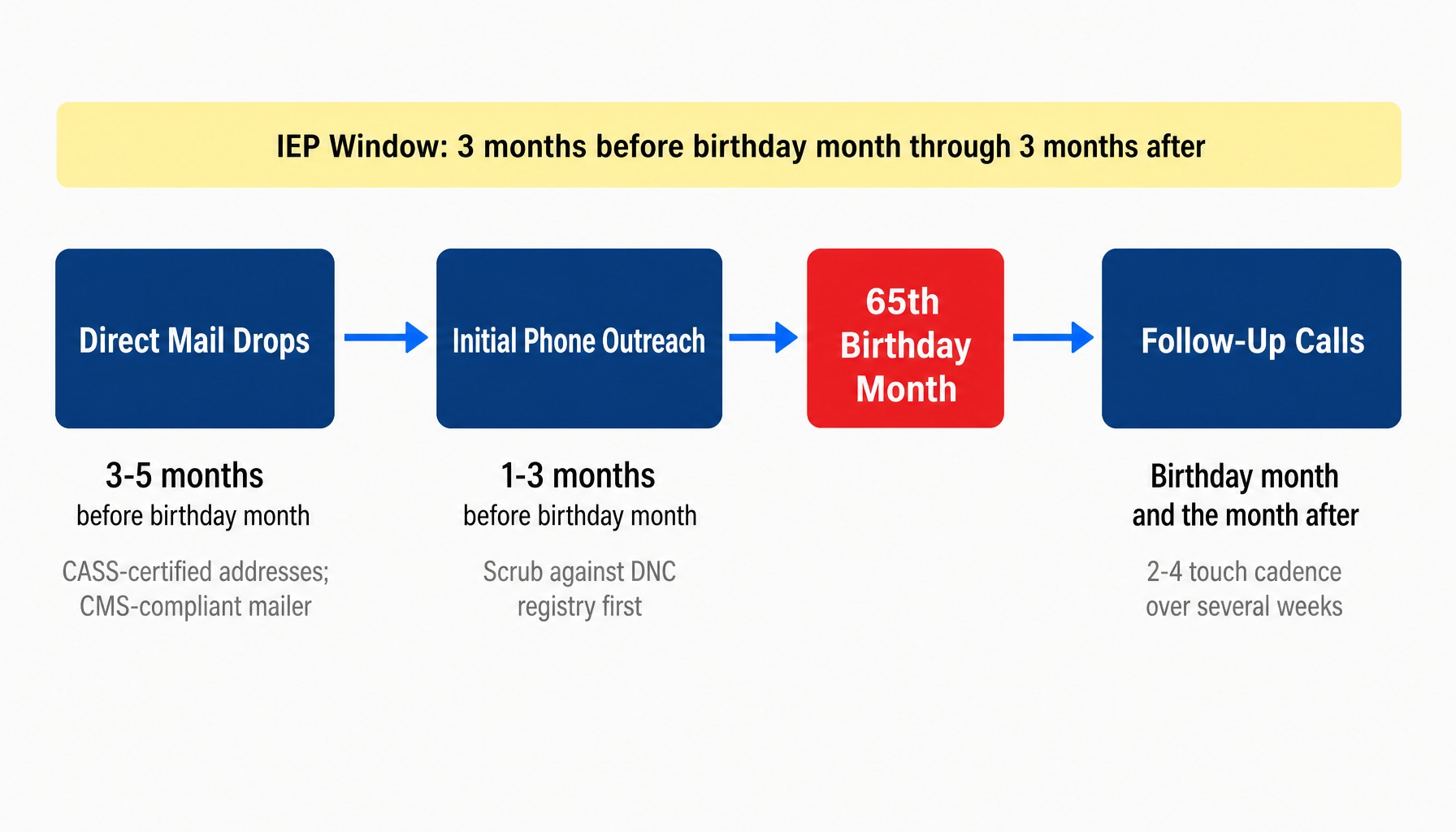
Relative to a prospect’s 65th birthday month, a multi-channel outreach cadence follows this sequence:
- Direct Mail Drops: 3-5 months before the birthday month
- Initial Phone Outreach: 1-3 months before the birthday month
- Follow-Up Calls: The birthday month and the month after
This schedule maps each outreach channel to a stage of the prospect’s IEP, from before the window opens through the month after the birthday.
Direct Mail Timing for Medicare Prospects
Direct mail is a common channel for Medicare prospecting because it reaches consumers at a verified home address. The timing is critical. Mail should arrive 3-5 months before the birthday month, at or before the point the prospect’s IEP opens.
The mail piece itself must comply with CMS marketing guidelines. It cannot include specific plan names or benefit details unless you have a prior Scope of Appointment. For the mailing to be successful, the list needs a verified address. This means the data should be CASS-certified (Coding Accuracy Support System) to standardize addresses and run through NCOA (National Change of Address) processing to catch recent movers. You, the agent, are responsible for ensuring your mailers meet all CMS and postal regulations.
Phone Outreach Timing and Cadence
Phone outreach typically begins closer to the birthday month within 1-3 months once the prospect’s IEP is underway. Before dialing, you must scrub your list against the Federal Trade Commission Do Not Call (DNC) Registry and any applicable state DNC lists. This is a separate and distinct obligation from CMS compliance.
The Telephone Consumer Protection Act (TCPA) also applies, governing consent requirements, auto-dialer use, and calling hours. A 2-4 touch cadence over several weeks gives you more than one opportunity to reach each prospect. If you work from telemarketing lists, plan the cadence and calling hours for each record before the first dial.
Saturation Marketing for Medicare Territories
Some agents approach Medicare prospecting through saturation marketing. In the Medicare context, this means pulling every consumer record in a defined set of ZIP codes or carrier routes who meets the age and demographic criteria, then contacting the entire territory systematically.
This approach suits agents who work a defined geographic territory and want a year-round T65 pipeline.
In practice, saturation means pulling all consumers aged 64-65 in the ZIP codes you cover and scheduling a quarterly mail drop to each cohort as it enters its IEP window. This is different from general consumer mailings. You mail only the households in the territory that pass the age filter, not every door.
Compliance When Contacting Medicare-Eligible Consumers
Any agent who contacts Medicare-eligible consumers by phone, mail, or email is personally responsible for compliance with all local, state, and federal laws. This includes rules from CMS, the Federal Trade Commission (FTC), and other regulatory bodies.
Your core compliance checklist should include:
- Scope of Appointment (SOA): You must have a signed SOA form from a prospect before you can discuss the specifics of Medicare Advantage or Part D plans.
- Do Not Call (DNC) Registry: You must scrub your calling lists against the national DNC registry and any applicable state lists before making telemarketing calls.
- Telephone Consumer Protection Act (TCPA): This federal law restricts the use of auto-dialers and artificial or prerecorded voice messages, and it sets rules for calling hours and consent.
- CMS Marketing Guidelines: CMS publishes detailed rules in its Medicare Communications and Marketing Guidelines, which are updated annually. These govern everything from what you can say in an ad to how you can use beneficiary contact information.
- CAN-SPAM Act (Controlling the Assault of Non-Solicited Pornography And Marketing Act): If you use email, you must comply with CAN-SPAM, which requires providing a clear opt-out mechanism and using accurate sender information.
Violations carry financial penalties. It is your responsibility to know and follow the current rules for each enrollment season.
Building Medicare Prospect Lists in InfoFree
The filters covered in this guide can be applied directly to a consumer database, whether you work the resulting list on its own or alongside leads you already buy.
Inside InfoFree, you can search a consumer database referencing approximately 270 million U.S. consumers and 170 million households. Using the filters discussed in this guide, you can:
- Search by age band or birth month to identify consumers turning 65.
- Filter by ZIP code, county, or radius to match your sales territory.
- Layer on homeowner status, estimated income, or home value to refine your audience.
You can then build a list for export or for outreach managed within CRM101, InfoFree’s integrated tool for tracking calls, emails, and notes. Export volumes depend on your plan tier.
For agents who also sell group plans and want to work alongside other producers, InfoFree’s insurance agent lists can identify potential referral partners or co-marketing opportunities in their territory.
For employer-group prospecting, InfoFree also includes a separate business database that you can filter by Standard Industrial Classification (SIC) or North American Industry Classification System (NAICS) code. Medical offices (SIC 8011, NAICS 621111) are usually run by a practice owner or office manager who decides on group benefits, typically on an annual renewal cycle, and they carry their own patient-privacy obligations under HIPAA. Coworking spaces (commonly classified under NAICS 531120) house small firms on short-term or month-to-month membership agreements, so the operator or community manager is the contact for referral partnerships rather than a group-plan buyer. Commercial kitchens (SIC 2099) tend to be owner-operated under food-safety licensing, and shared-kitchen facilities rent space to tenants on hourly or monthly contracts. Confirm each business’s headcount and the contact’s role before outreach, since group-plan eligibility depends on both.
Conclusion
A Medicare lead is a filtered consumer record, whether it comes from a lead vendor or from a database pull. The filters behind the record determine its territory coverage and enrollment timing.
By understanding the enrollment windows that create opportunity, applying the right data filters to define your audience, timing your outreach, and adhering to strict compliance standards, you can build a systematic and repeatable prospecting process. Refreshing each list on the same schedule as the enrollment calendar keeps every record tied to a window the consumer can still act on.
Frequently Asked Questions
1. How far in advance of a consumer’s 65th birthday should I start outreach?
For direct mail, 3-5 months before the birthday month gives the piece time to arrive and the consumer time to respond before their IEP window narrows. For phone outreach, 1-3 months before the birthday month is typical. Both timelines assume you will obtain a Scope of Appointment before discussing specific plan details. Obtaining that SOA, like every other compliance step, is your responsibility under local, state, and federal law; InfoFree is not liable for how you use the data.
2. What is the difference between aged Medicare leads and current prospecting data?
An aged lead is a record generated weeks or months ago and not converted by the original buyer; it is resold at a lower price. Current prospecting data is a consumer record you pull directly from a database using date-of-birth and geographic filters at the time you need it. The main difference is record age: an aged lead has already been worked by at least one buyer and may be past its enrollment window, while a fresh pull reflects where each consumer stands today.
3. Can I email Medicare-eligible consumers from a prospecting list?
Email outreach must comply with the CAN-SPAM Act and CMS marketing guidelines, which restrict unsolicited electronic communications. Agents should verify current CMS rules for the enrollment year, as these can change. You are responsible for compliance with all applicable local, state, and federal laws, and InfoFree is not liable for how you use the data.
4. How do dual-eligible beneficiaries differ from standard T65 prospects for targeting?
Dual-eligible consumers qualify for both Medicare and Medicaid and may be eligible for Dual-Eligible Special Needs Plans (D-SNPs). Targeting this group requires income or benefit-status indicators that not all consumer databases carry, and outreach is subject to additional CMS and state Medicaid agency compliance rules.
5. How often should I refresh a Medicare prospect list to keep it usable?
For T65 lists, refresh at least quarterly to capture new consumers entering their IEP window and remove those whose window has closed. For AEP lists, build or refresh 6-8 weeks before October 15. A consumer whose IEP has closed no longer belongs on a T65 list, though they may still fit an AEP or SEP list.
6. Are there restrictions on using SIC or NAICS codes to cross-sell Medicare-related services to businesses?
Agents prospecting employer groups or senior-care facilities can use SIC or NAICS codes to identify medical offices (SIC 8011, NAICS 621111), where the practice owner or office manager usually decides on group benefits at annual renewal, or assisted living facilities (NAICS 623312). This is a business-to-business (B2B) prospecting use case, but whether CMS rules apply depends on what you are offering and to whom, so confirm current CMS guidance before outreach; standard B2B telemarketing and email laws still apply. Following local, state, and federal law in that outreach is your responsibility, and InfoFree is not liable for how you use the data.